

Half a Loaf
We’ve been taught that “it’s better than none.” But is it?

For the past week, I’ve been living life with only one of my pair of two-month-old hearing aids. The previous weekend, the right-side one started running out of juice way before it was supposed to, and the run length was dropping dramatically every day. Suspecting I had a bad battery, I took it to Costco, where my diagnosis was confirmed, and, sadly, the fix required shipping it back to the manufacturer. On the way out, the clerk handed me my one good hearing aid and uttered that infamous “Half a loaf is better than none” idiom.
It depends on the context. To begin, a history lesson. The phrase is old, first recorded in John Heywood’s 1546 book of proverbs:
“Throwe no gyft agayne at the giuers head, for better is halfe a lofe then no bread.”
As a gift (or “gyft”), sure; half a loaf beats no loaf. But if you paid for an entire loaf? A different story. I guess I should be lucky that it was the right aid that was faulty, as that was my “better” ear, except that hearing aids work best as a pair, and my brain was just getting to the point of learning the nuances of having those amplifiers/clarifiers turned on.
I am less than satisfied. I don’t like to be unsatisfied. I suspect no one does, really, and nowadays, it appears hardly anyone is satisfied. Everywhere I turn on social media, someone is complaining about something (and obviously, I count myself among that group). But how unsatisfied are we?
Calling Dr. Likert!
You may not know the name (or how to pronounce it – it’s a short “i” as in “lick”), but Dr. Rensis Likert was the dude who came up with the format that you all know and love from countless surveys, like so:
You enjoy reading Mike’s Substack:
Strongly Disagree
Disagree
Unsure
Agree
Strongly Agree
Or variations on that theme, such as the one we often see regarding satisfaction with a product or service:
Very dissatisfied
Somewhat dissatisfied
Neither satisfied nor dissatisfied
Somewhat satisfied
Very satisfied
Researchers hailed his Likert Scale as an effective measuring tool, but I have always had a love/hate relationship with it (and with the man, as he was also credited with the “open-ended question,” and I have absolutely no use for those). For one thing, the 5-step scale is sort of arbitrary (one popular version is a 7-step scale, adding Somewhat Disagree and Somewhat Agree on either side of the Unsure, though I’ve seen everything from 2-step to 10-step scales). It can be biased with uneven steps (like: Poor, Average, Good, Very Good, and Great). And if you use an odd number of steps, it always leaves the respondent with the wishy-washy middle choice.
I like giving the choice of TWO responses, because an even number of choices pushes the respondent to one side or the other, and frankly, I’ve always been a proponent of making it (a) simple and (b) definitive.
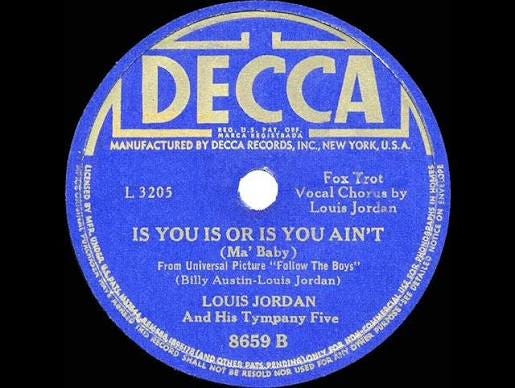
And there ain’t no inbetweenin’ here. Obviously, I’m an “ain’t” (not satisfied), but there’s little I can do until I hear back from Costco (no pun).
Your thoughts…
Please note—Mike’s Substack is free and always will be. I make my money from my paperbacks and ebooks, so if you want to buy one (or more), that’d be great, including my new novel, The Heart Before the Course. ⛳
You’ll find everything at the link below, or ask your local bookstore if I’m in stock (and if not, they can order any of them through Ingram):
And in case you’ve gotten this far without being a subscriber…